Inside the world of the celebrity assistant
They're the unsung heroes of showbiz - the assistants who pander to every whim of Hollywood's pampered A-list. Guy Adams enters a world of paranoia, poodles, and lobster thermidor at 2am. | 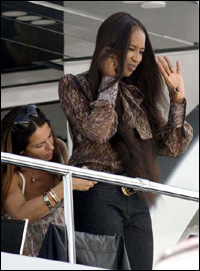 | | Naomi Campbell is spotted on a yatch as she talks on her mobile phone whilst being attended to by an assistant | | It was surprisingly straightforward to gatecrash the summer drinks party of the Association of Celebrity Personal Assistants. This secretive group had arranged to meet at The Farmer's Daughter, a fashionable but far-from-exclusive hotel on the outskirts of Beverly Hills. By arriving early and bagging a table adjacent to their reserved section, it was possible to eavesdrop on proceedings while nursing a cocktail and pretending to read that day's LA Times.
Shortly before 6.30pm, the first guest arrived: a tall, elegant black woman whom I took to be Kimberly Logan. In her day job, Logan manages the life of a prominent TV comedian called Cedric the Entertainer. In her spare time, she's president of Acpa, as members call their organisation. This job carries considerable kudos. And as Logan had gently explained during several phone calls that week, it also confers the power to refuse journalists permission to attend Acpa events, even on an off-the-record basis.
Next came a blonde in a summer dress. Then, a shorter fortysomething woman wearing jeans and sensible shoes. Going by online pictures, she closely resembled Becky Pentland, who is PA to Roseanne Barr, and one of Acpa's leading lights. In a bizarre love triangle, Pentland also happens to be married to Barr's ex-husband, Bill Pentland; I'm not sure how this arrangement works, since she'd been impossible to raise for an interview. But I'd sure like to find out.
Acpa's members have one hell of a job. They are the bag-carriers, tit-tape holders, and herbal tea-makers to the Hollywood elite. They run homes, reign over private offices, and cope with the tackiness, tantrums and downright weirdness that accompanies extraordinary fame. They are integral to Hollywood folklore - and studying them is one of the few ways we can see what the biggest stars are really, really like.
Where, for example, would our understanding of Jennifer Lopez be without the knowledge that she travels with not one, but two assistants (one to pluck each eyebrow)? Would Mariah Carey still be Mariah Carey without an entourage of nine, one of whose jobs is, reportedly, carrying her Evian?
How differently might we still see Jude Law, if he hadn't been exposed for cheating on Sienna Miller with assistant Daisy Wright on a film set in New Orleans? How, more to the point, would celebrity culture exist without hard-pressed courtiers to provide the trappings of royalty to this modern breed of monarch? Could we, the public who lap up every detail of their lives - particularly the ugly bits - survive without the dirty laundry that gets washed each time a star's relationship with an assistant goes wrong? Because when that happens, things really do go properly wrong.
This week, supermodel Christie Brinkley is locked in a Long Island divorce court facing her estranged husband Peter Cook, who ran off with his 18-year-old assistant Diana Bianchi in 2006. The couple had been married for a decade, raised a daughter together, and Cook was aged 47 at the time of the affair. Bianchi is due to give evidence for Brinkley's side.
The Brinkley-Bianchi case, however, will serve as a mere entrée to the celebrity court case of the summer: the battle between Rob Lowe and two former assistants, Jessica Gibson and Laura Boyce, which returns to court within the next few days. Their extraordinary wrangle involves allegations of sexual harassment, casual racism, and a plot to extort money. The West Wing star stands accused of - and, it must be stressed, strongly denies - exposing himself to the teenaged Gibson, and "putting his hand inside her pants in order to touch her crotch".
Acpa's latest "mixer/happy hour" event took place last Tuesday, as teams of lawyers put the finishing touches to their submissions in these high-profile cases. By 8pm, the gathering had swelled to roughly 20 people. It broadly reflected Acpa's 125-strong membership: three-quarters female, average age mid-to-late-thirties. Most wore casual, yet practical clothes: jeans and a blouse for the ladies; shirts for the men. (In Hollywood, super-assistant Josef Csongei had recently informed me, suits are strictly for agents - though "you might dress up if Nicole is coming round for dinner.")
Topics of conversation included the impending actors' strike; Angelina Jolie's twins (they hadn't arrived last week, despite TV reports to the contrary); and a red-carpet security man who recently committed the faux pas of passing his business card to Val Kilmer in the hope of securing freelance work.
As guests began dipping into the cocktail list, snippets of more colourful gossip began to emerge. Someone called Charlie "has terrible table manners". Tom (Hanks? Cruise? Petty?) wants to home-school his kids, and is scouting for a tutor. Minnie Driver's baby-shower, in Malibu last week, was "simply divine".
Watching the evening unfold, It was plain that there's more to celebrity assistants than meets the eye; they are, perhaps, some of the great unsung heroes of public life. People brave enough to serve devotedly the likes of Naomi Campbell, who boasts a conviction for assault on a member of her staff, using a mobile phone. People clever enough to defuse the legendary tantrums of Tyra Banks - whose favourite former assistant, Bradford Sisk, runs her multi-million dollar production firm, Bankable.
And while many commentators dismiss assistants as ghastly fame-junkies, or call them parasites feeding off a bloated Hollwood elite, the more you watch and learn about them, the more you realise that there's lots more to being a professional celebrity sidekick than meets the eye. Suppose you woke one morning and decided to devote the rest of your career to organising a famous person's life. Your first step might involve a training seminar organised by Rita Tateel. About twice a year, Tateel runs a class for would-be celebrity assistants through The Learning Annex, an adult education centre in Los Angeles. This is the industry's version of Oxbridge.
The seminar offers a step-by-step guide to "assistance", talking through ethics, work environments, and the 50 or so key professional skills it requires. Tateel highlights the job's benefits (glamour, travel, free luxury goods) and the drawbacks (long hours, stress, "people using you for whom you work" and "the loss of sense of self"). Broadly, though, her advice can be condensed into a single point: all assistants must eliminate the word "no" from their vocabulary.
"If you gossip, it isn't the job for you," she says. "If you get sick, it isn't the job for you. You have to be organised. You have to be able to multi-task, and handle lots of serious pressure," she says. "Those are skills you either have or don't. I've done about 45 seminars. Most people come, take it, and afterwards say there's no way they'll ever be an assistant. But a few get to the end and go: 'Absolutely! That's exactly what I want to do with my life.' "
According to a survey by Acpa, celebrity assistants earn between $30,000 (£15,000) and $105,000 a year (the average is $61,000). They work between six and 16 hours a day (the average is 10) and are expected to report for duty five to six days a week, normally, and seven days a week at "special" times. They travel constantly. The standard Hollywood assistant is 38 years old, female (81 per cent) and gets medical insurance (71 per cent) but not dental cover.
In the unlikely event that Tateel has failed to dissuade you, and you still fancy pursuing a career as an assistant, the next step is to get hired. Famous people seldom advertise openly for staff; instead, they generally hire by word of mouth, or offer jobs to people they run into on, say, movie shoots.
So, you could take a runner's job on a film set or in a music studio and hope to get picked up. But it's not a given. A more reliable policy might be to join the books of a specialist recruitment firm, such as Malibu-based Celebrity Services and Staffing (CSS), run by Jessica Doran, Salma Hayek and Kristen Johnston's former assistant.
Doran's website boasts glowing endorsements from both her former employers. Salma Hayek claims that "CSS is essential to everyone who wants balance in their life". Kristen Johnson is more gushing, describing her as a "sanity touchstone" and "the classiest, kindest, most discreet (not to mention fun) person I've ever had the pleasure of working with!"
Good assistants, Doran says, have three qualities: they need to be an executive assistant (someone who runs an office), a personal assistant (the person who books doctors' appointments and answers party invitations) and an estate manager, normally for several homes.
"I also look for people who aren't critical," she says. "Assistants are going to be in a celebrity's life a long time, and it's important they realise that not everybody's perfect. Celebrities might get overweight or have problems and don't want someone around who will be negative or critical behind their back."
Doran works like any head-hunter. She carries out background checks. She interviews potential candidates, examines their credit history, establishes that they don't have a criminal record. She tailors searches individually - and for this, she charges between 12 and 15 per cent of the first year's salary.
That may seem a little steep, but famous people can be demanding. Last year the TV documentary Victoria Beckham: Coming to America revealed how Britain's celebrity queen vetted applicants for her PA's job to make sure they weren't too thin. Cynics at the time wondered if it had something to do with that Rebecca Loos business involving her husband.
"I know how to weed out bad candidates," adds Doran. "If they start gossiping about Cher, or discuss anyone they work for, that is a big no-no. And hey, I'm sure someone like Rob Lowe wouldn't mind paying not to have a bad assistant in his life any time in the future." In a recent TV documentary, The Business of Being Born, the chat-show host Ricki Lake recalled her decision to bring son Owen into the world via a home water-birth. Smiling joyously at the camera, she joked: "Still, to this day, my assistant talks about how she had to clean up the bathtub afterwards!"
To cynics, this summed up all one needs to know about life as a Hollywood assistant. The impossible intimacy; the menial, and occasionally disgusting tasks you're expected to perform. The soul-destroying way that no one, not even your employer, refers to you publicly by name. You are simply "my assistant" - the non-person who gets to clean up Ricki Lake's afterbirth.
Speak to those in the profession, though, and a different picture emerges. Assistants are for the most part happy; they feel deep affection for their employers, and are generally well treated. They're in a glamorous line of work, and if that means occasional unpleasantness, then so be it.
Bonnie Low-Kramen has worked for Olympia Dukakis for 22 years, and recently published a manual called Be the Ultimate Assistant. "People like me are seen as a luxury, or an indulgence, or some sort of fashion accessory," she says. "That's a complete myth. By having an assistant, a celebrity gets free time to make more money, and who doesn't want to do that?"
"By employing me, Olympia gets to do things that only she can do." "I take care of all the other stuff. Only she can learn her lines, for example, or go to dress fittings - though I did once go to an eye doctor to check that her frames fitted. But why should Olympia Dukakis spend her time worrying that the cleaner's coming, or paying household bills?"
Low-Kramen has become friends with Dukakis - "I was at her kids' weddings, her family came to my son's bar mitzvah" - but is anxious to stress that their relationship is "primarily business". She takes a dim view of assistants who end up facing former employers in court, and says that it's often when the borders between a friendship and a business relationship get blurred that conflict ensues.
Plenty of assistants do become matey with their boss, though. "Some get helplessly involved, like one woman I met who had looked after Sharon Stone, and then Dennis Hopper," says Jake Halpern, who interviewed dozens of assistants while researching his book on modern celebrity, Fame Junkies. "Then you get some others, like Nick Nolte's assistant, who struck me as much more professional; but then, Nolte isn't the kind of man who'd send you out because he desperately wants lobster thermidor at two in the morning."
Others struggle to achieve friendship at all. Lilit Marcus, an ex-assistant (she's unable to name her former employer for legal reasons) runs an internet site called savetheassistants.com, which provides a sort of support service for disillusioned sidekicks. Her site contains links to assistant "horror stories" elsewhere such as on Perezhilton.com, which recently claimed that David Hasselhoff's assistant's duties include handing his business card to eligible women in LA nightclubs.
"The worst side of it is where assistants become another form of wealth, to be shown off," she says. "Like in the new Sex and The City film, where Carrie gets an assistant a sort of fashion accessory to prove that she can afford not to do menial tasks."
Without exception, though, experts say the most convincing cinematic portrayal of a celebrity assistant was that achieved by Ann Hathaway in The Devil Wears Prada. "One of my favourite parts is when she's talking to her boyfriend and the phone rings, and she gets ready to answer it, knowing it's going to be her boss," says Shelley Anderson, assistant to Oprah Winfrey's favourite self-help guru Louise L Hay and author of the book Dealing With Divas. "Her boyfriend says the person you are really having the relationship with here is not me, it's the celebrity. That is so true. Because to do this job, you'd better not have any plants, pets or people in your life. It's a can-do career and you've got to be prepared to sacrifice everything. But don't give the impression that we hate it; people like me wouldn't do it if we did." Back at The Farmer's Daughter, the can-do brigade is letting its hair down, in a very "can do" manner. A small mountain of mobile telephones and BlackBerrys are lying on tables, and they are not hitting the bottle in the manner of, say, a group of city PAs during a night out in London's West End.
But Acpa is not merely a social organisation. It exists to help members do their job better. The association's website boasts a (private) bulletin board, where members can post requests for help, and carries job ads. The organisation also publishes its own Yellow Pages: a directory of suppliers and services (anything from discreet plumbers to good tennis coaches).
"You want an example of how we're useful?" said Kimberly Logan, during a phone call when I'd wondered out loud what sort of person might decide to join a masonic-sounding organisation for celebrity assistants. "One time a TV star wanted dancing poodles for a child's birthday party. Her assistant had no idea where to go for them, but a 'help me' message got posted on our website, and she found one in hours."
Perhaps, then, something like Acpa is just a natural by-product of an industry that requires perfectly ordinary people to be incredibly resourceful. Watching celebrity assistants in a herd - often the best way to observe human behaviour - they certainly seem smart, respectable, and hard-working.
"The biggest myth is that we're mindless, brainless people who just get told what to do," adds Logan. "You see these movies that show us being ordered to make coffee, and suddenly people think we do a stupid job. In fact, most of our members have college degrees, some have a Masters, and one has a doctorate." Logan particularly dislikes a recent genre of pulp novels, bearing titles like Chore Whore and It's All Your Fault.
Actually, people like Logan are nobody's chore whore. Instead, they a weirdly varied lot, who play a variety of roles - from Waylon Smithers to their bosses' Montgomery Burns (The Simpsons), to Anthony Hopkins in Remains of the Day, who remains calm when all around are losing their heads. And without proper assistants, stars tend to fall off the rails (witness Britney Spears or Amy Winehouse).
The problem is that like any courtiers, they can corrupt the people they serve. "Assistants make sure these people who employ them never hear any negative feedback. And that's very dangerous," says Jake Halpern. "A Cornell psychiatrist has identified a condition called acquired situational narcissism, whereby over long periods of time, if you are constantly in a situation where you're only told what you want to hear, it has a corrosive affect on your psyche. You become prone to rage and paranoia, or start doubting what you're told. And that is why celebrities have tantrums."
Even Rita Tateel admits fame breeds insecurity. "I've been working with celebrities for 20 years, and they are the most insecure people on the planet, for one reason: if you consider putting yourself in their shoes, and stepping outdoors and find people are always very nice to you. Well, you have no idea if they are being sincerely nice, or if they have a hidden agenda and want to get close to you because fame is power. So part of being famous is tremendous insecurity."
And it is while getting lost in these thoughts at The Farmer's Daughter that I look up to see one of the guests at the Acpa party, and notice (to my horror) that it is Josef Csongei, a former assistant to Stanley Kramer and Diane Ladd, whom I'd interviewed during an off-the-record lunch the previous day. I duck behind the LA Times, but am pretty sure I catch his eye, and that it registers a look of astonishment.
About five minutes later, a waiter approaches with the bill, saying my table's been booked for dinner. Am I being thrown out? It's difficult to say, but it certainly feels that way. The world of the celebrity assistant is, by its very nature, an exclusive one, and I had certainly not been invited into it. (The Independent)
|